
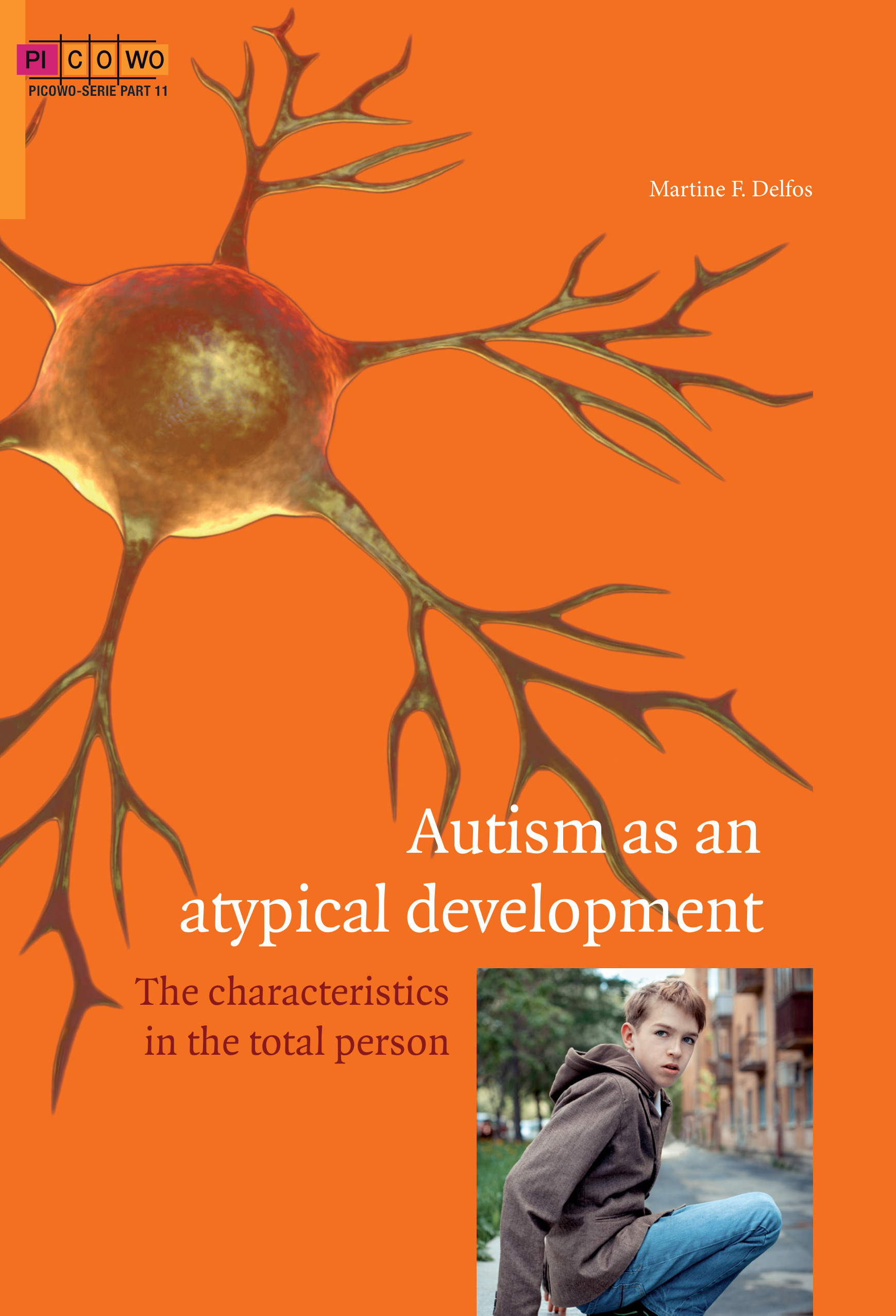
In Autism as Atypical Development, Martine Delfos describes for the first time the characteristics of autism as derived from the Theory of the Socioschema, using the MAS1P (Mental Age Spectrum within 1 Person) – the spectrum of mental ages within a single person. She clearly describes how these characteristics are interrelated and how they logically follow on from one another. There are four characteristics, plus two that result from how a person with autism encounters the world and how the world encounters that person. Compared to older theories, the recognisability of these characteristics for people with autism and those around them is very high and can be translated into how to deal with them and how to prevent problems. Martine Delfos uses nearly 100 real-life examples to show what atypical development looks like in everyday situations and at different ages.
By her own account, she has never been so clear in her explanation of autism. The book also includes a chapter by John Huijbregts, a Year 7/8 special needs teacher who works with children with autism.
The book is suitable for anyone with autism; although it is about them, it is certainly intended for them, their families, those around them and teachers. It is also suitable as a training manual, as it sets out the background and rationale. The book aims to provide a better understanding of autism, how it affects each individual with autism differently, and how to deal with it: in relation to oneself, in parenting and in education. Attention is paid to the workplace, but to a lesser extent, although the information provided applies to every situation.
John Huijbregts, a special needs teacher in a class with pupils with autism:
Something happened when I started applying this new way of looking at things in my approach to pupils with autism in the classroom. It was no longer what we call ‘their shortcomings’ that came to the fore, and it was no longer me, as the teacher, who knew exactly what was best for them; instead, they began to tell me things. I gained an insight into their world (and how they think) and came to know my pupils in a different way. A completely different perspective unfolded. Their qualities and potential came to the fore. They began to tell me things. I learnt to listen and received the most fascinating answers from the children themselves. A whole new world opened up to me...
''Martine Delfos uses nearly 100 real-life examples to illustrate what atypical development looks like in everyday situations and at different ages. It is a book for anyone with autism, their families and those around them, as well as teachers.''
- Psyche Magazine, 2022
Biopsychologist Martine Delfos views autism as atypical development, as the title of her latest book suggests. According to her, it involves a disharmonious developmental profile,
which she describes using the acronym MAS1P, meaning ‘mental age spectrum within one person’. In her view, heightened sensitivity to stimuli can also play a role. Through countless examples, she demonstrates that establishing contact based on understanding offers many opportunities for development and for changing undesirable behaviour. Delfos’s style is well-crafted, and the message is well worth reading. In the final chapter, John Huijbregts, a special needs teacher, summarises this very clearly and explains the positive impact that applying Delfos’s theory has had on the children in his class.Medisch Contact (dec, 2021)
''I also read *Autism as Atypical Development* with a sense of recognition and understanding. For example, feeling that disconnect from the world, the fear of learning, and how, as a young person, I completely undermined my self-image. Self-determination and my tendency to suppress my feelings through compulsive behaviour are also recognisable. I understand even better why I could never just ‘go with the flow’. And having so many thoughts but being unable to share them, so that others don’t know about them, is partly why I blog.”
- From a review of Mandy, StoerLeesVoer
''This book teaches you to look at the development of people with autism in a different light and how to deal with it. (...) People with autism recognise themselves in the characteristics described here. For researchers and those who work with or interact with people with autism, it offers a different perspective on individuals with atypical development. (...).
The book contains various examples of moments when the author is talking to people with atypical development. These are wonderful conversations in which surprising changes occur in the behaviour of the person with autism. (...)
This book is highly recommended for anyone wishing to learn more about autism.''
- From a review in the *Nederlands Tijdschrift voor Logopedie*, vol. 94, no. 2, May 2022
BV Uitgeverij SWP
Postbus 12010
1100 AA Amsterdam-Zuidoost
Bezoekadres:
Spaklerweg 79
1114 AE Amsterdam-Duivendrecht
020 - 330 72 00
020 - 330 80 40
klantenservice@mailswp.com