

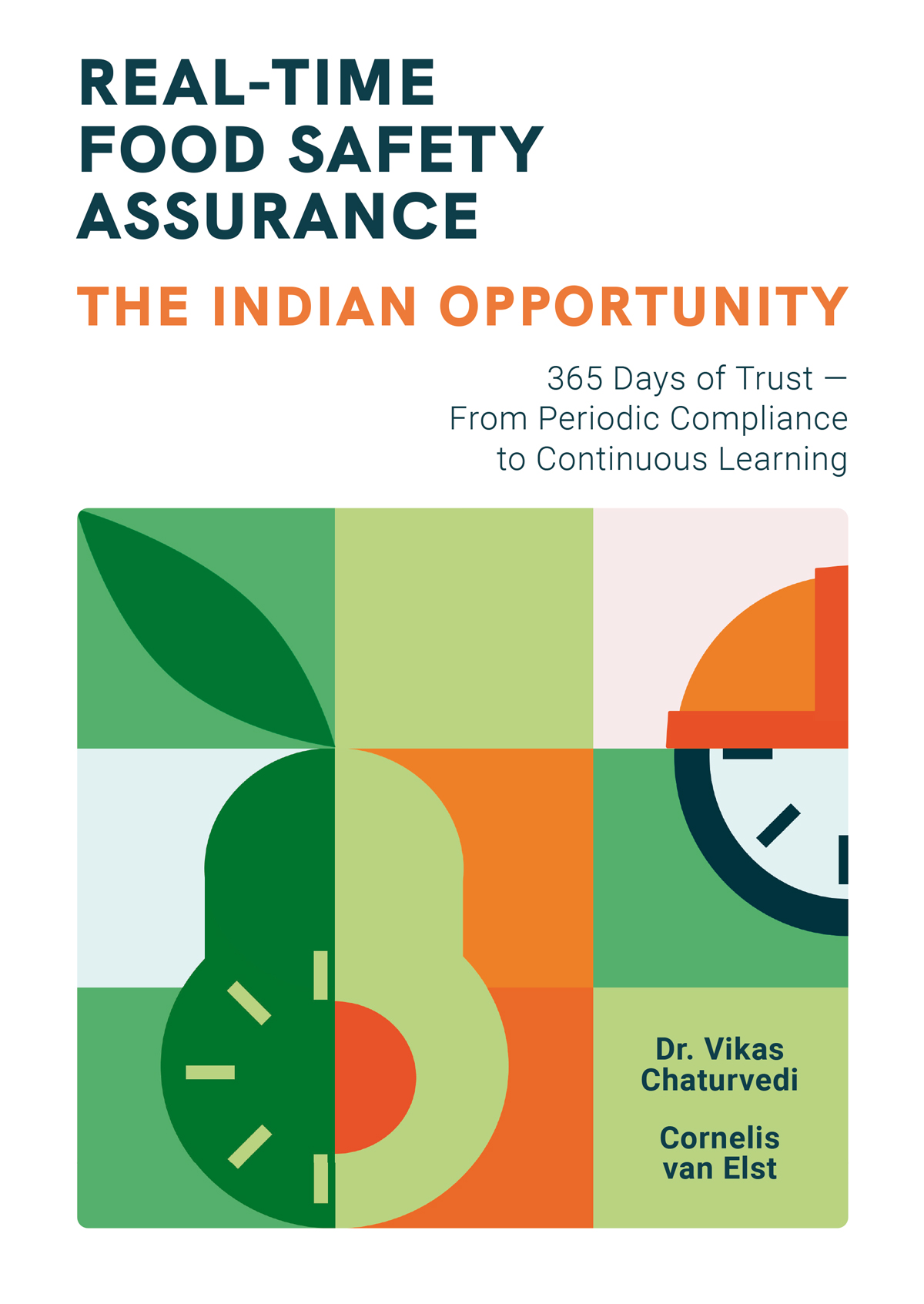
Modern food safety does not need more audits.
It needs better system intelligence.
This book reveals why certification-driven assurance struggles to keep pace with today’s food systems — and how real-time learning, structured knowledge, and intelligent infrastructure restore control. Moving beyond compliance without abandoning it, the author offers a system-level perspective on resilience, assurance, and governance.
For food safety professionals, regulators, and leaders who sense that the system must evolve — not because it is broken, but because the world has changed.
Preface
Beyond Supply: Repositioning India in Europe’s Food Economy
Discussions of food safety are typically centered on rules, standards, audits, and certif-
icates. These elements define how assurance is organized and communicated.They are important, but also incomplete.
In the context of India’s agri-food system—with its scale, diversity, and strong MSME
base—this becomes especially visible. Many assurance models function as designed,
yet struggle to keep pace with increasing complexity, global trade demands, and rising
expectations from international markets.
The result is not failure, but strain. Producers, exporters, auditors, and regulators
all work harder within systems that still prioritize periodic proof over continuous
understanding.
This book does not argue against standards or certification. It assumes professionalism
and good intent across the system.Its purpose is different.
The chapters that follow explore food safety as a learning system—one that builds
intelligence, adapts to complexity, and enables continuous assurance across fragmented
supply networks.
They ask:
– How can India move from volume to value in European markets?
– How can MSMEs become drivers of precision and differentiation?
– What does assurance look like when it operates continuously, not episodically?
The perspective is grounded in practice and real-world system behavior. The intention is
not to replace existing models, but to complete them.
Compliance provides structure.
Learning provides adaptability.
Assurance becomes credible when both are designed together.
For India, this is a strategic opportunity.
The transformation ahead is not about doing more.
It is about learning better.
BV Uitgeverij SWP
Postbus 12010
1100 AA Amsterdam-Zuidoost
Bezoekadres:
Spaklerweg 79
1114 AE Amsterdam-Duivendrecht
020 - 330 72 00
020 - 330 80 40
klantenservice@mailswp.com